

A guest steps out of the shower. What happens in the next three seconds — the moment they reach for a towel — shapes their entire impression of how well the property cares for them. It is a small window, and most hotels waste it.
The bathroom is the most intimate space a hotel offers. Yet it is consistently the area where procurement decisions default to cost-per-unit rather than sensory outcome. The result is predictable: towels that scratch, thin waffle robes that offer no real warmth, bath mats that flatten after a week of laundry cycles. Guests notice. They simply don’t always say so aloud.
What they do instead is leave. Or they stay — and remember the bathroom that finally felt like it understood what they needed. That memory is what O Boutique designs for.
The Challenge: Weight, Absorbency, and Durability
Bathroom textile sourcing involves a tension that most suppliers don’t acknowledge honestly: the qualities guests love most — extreme softness, heavy weight, rapid absorbency — are also the qualities that deteriorate fastest under commercial laundry conditions. A 700 GSM zero-twist towel feels extraordinary on the first use. After forty industrial wash cycles at 60°C with commercial detergent, its loop structure may have collapsed entirely.
The property briefing us operated a 32-room boutique resort with two daily towel changes per occupied room. Their existing stock, purchased from a standard hospitality supplier three years prior, was already thinning noticeably. They needed a solution that held its quality across a minimum of 200 wash cycles — the hospitality industry benchmark for commercial bathroom textiles.

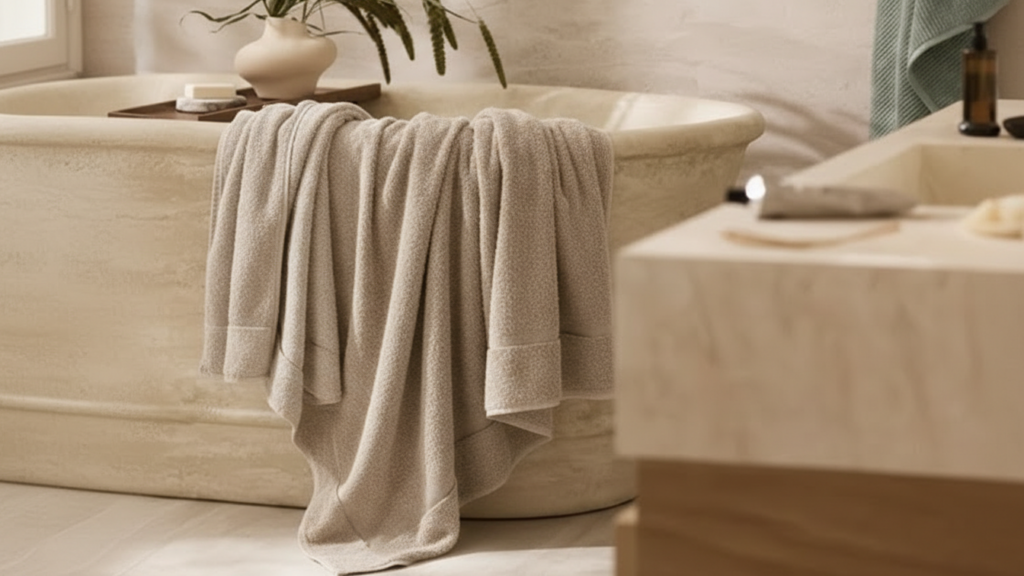
Beyond durability, they wanted a bathroom textile program that felt cohesive — not an assortment of unrelated pieces, but a considered family of products that communicated the same values from bath sheet to hand towel to robe.
Finding the Right Construction
O Boutique presented three towel constructions for evaluation: a ring-spun cotton in 550 GSM, a zero-twist combed cotton in 600 GSM, and a cotton-bamboo blend in 580 GSM. Each was submitted to a twelve-week wash test before any aesthetic decision was made.
The zero-twist construction proved the strongest performer across all criteria. Its long, untwisted loops create a larger surface area per gram of cotton, which translates to faster moisture absorption without requiring extreme weight. The combed cotton yarn — where short fibres are removed before spinning — also meant the towel shed minimal lint from the first wash onward, a practical advantage in a property managing high laundry volumes.
Results: When Guests Notice Without Knowing Why
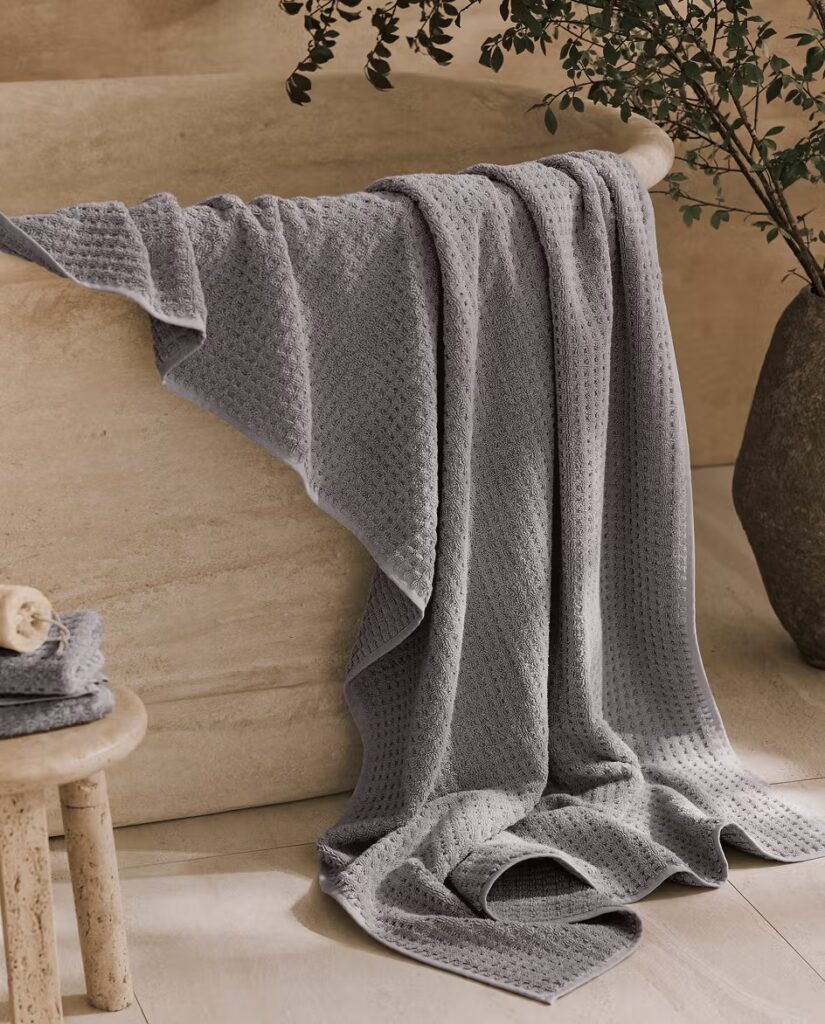
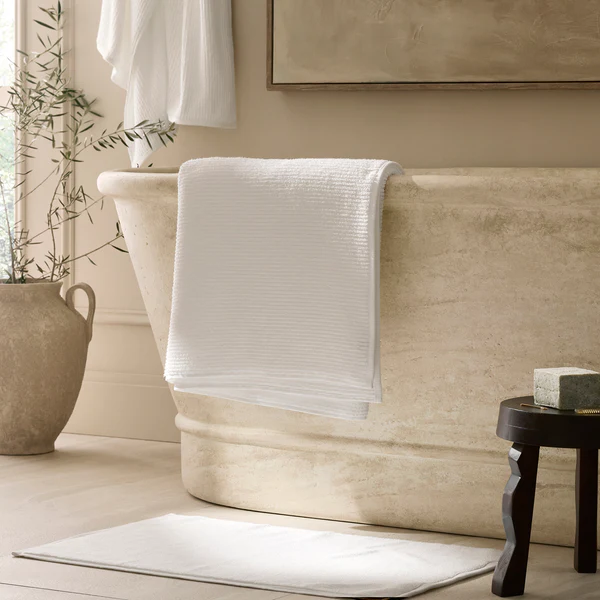
The full bathroom collection — bath sheets, hand towels, face cloths, bath mat, and hooded robe — was installed across all 32 rooms over a single turnover weekend. Within the first guest review cycle, bathroom mentions in positive reviews increased significantly. The language guests used was telling: words like “cloud,” “wrapped,” and “didn’t want to leave the bathroom” appeared repeatedly.
None of those guests mentioned thread count or GSM. They described sensation. That is precisely the outcome conscious textile design works toward — not a specification guests can articulate, but an experience they cannot forget.
The robe completes the program. Cut generously, with wide shawl collar and deep patch pockets, it is made from the same zero-twist cotton in a looped terry construction. The weight — 380 GSM for the robe fabric — is sufficient to feel substantial without being heavy to wear. Belted loosely, it reads as a garment rather than a utility item, which matters in a property where the bathroom is also a space guests spend time in, not merely pass through.
"We've always invested in the room. O Boutique made us understand we hadn't yet invested in the bathroom — and that was where our guests were forming their final impression."
kate Millor Tweet

Blending Function with Craft
The border detail — a narrow woven stripe in a tone slightly deeper than the ground — appears on every piece in the collection. It is the kind of detail guests sense without cataloguing: a signal that the towel was designed, not simply manufactured. Combined with the dobby weave border on the bath mat and the single-needle topstitch on the robe collar, it creates a visual language that reads as intentional at every scale.
Bathroom textiles, done well, are the hospitality equivalent of a firm handshake. They communicate competence, care, and a willingness to invest in the guest’s comfort at the moment it matters most. They require no explanation. They simply work — wash after wash, guest after guest, season after season.
I look forward to seeing how these developments will improve service levels and customer satisfaction in the freight industry!